

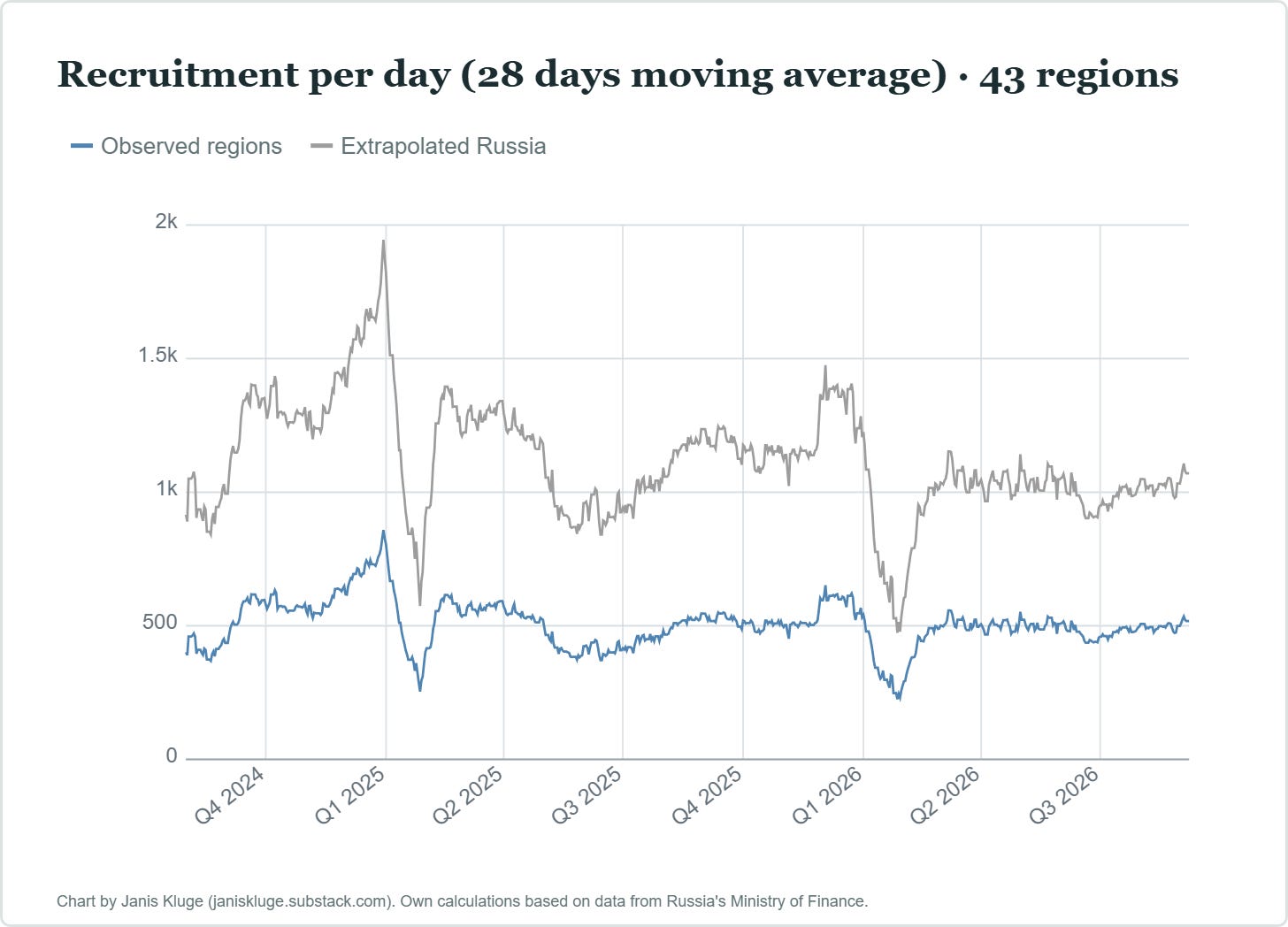
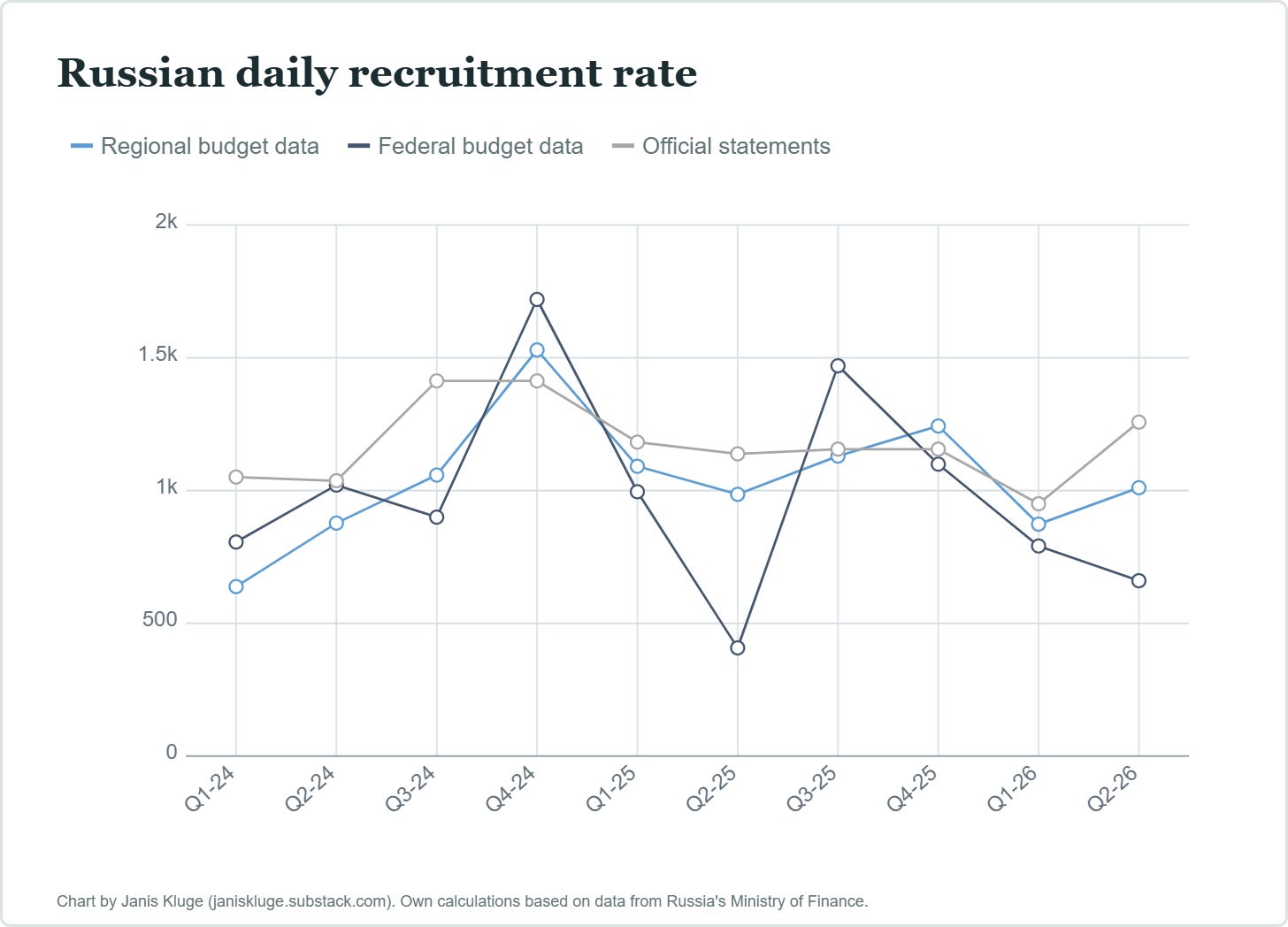
Regional recruitment spending remained largely stable in August, at a pace that indicates around 1,000 new contracts per day. That is 20% below the level in August last year. While it is difficult to draw conclusions from individual months, the data continues to indicate a somewhat lower rate of recruitment than in 2025 - despite significantly higher payouts and a sharp increase in coercive recruitment practices in many regions.
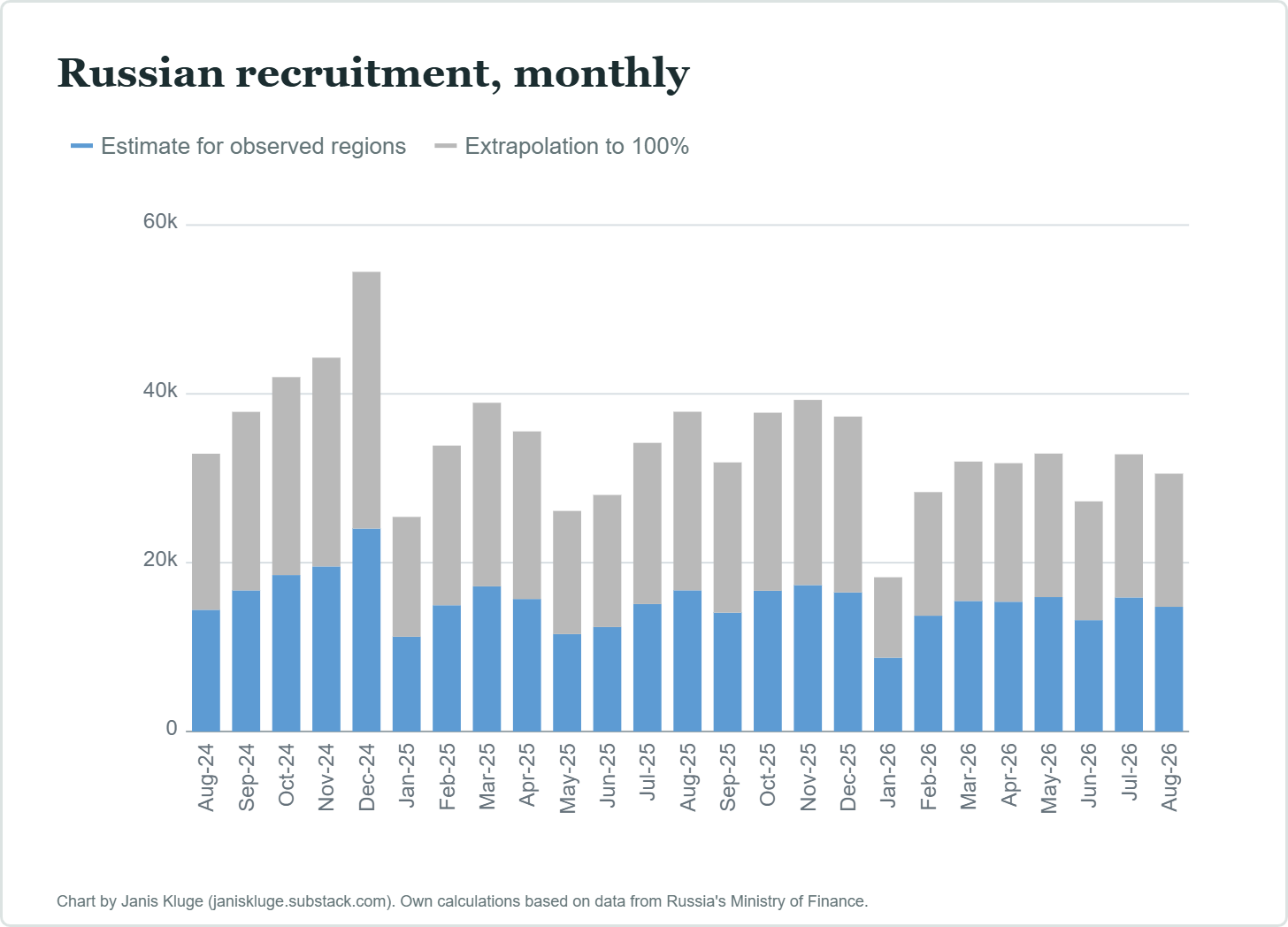
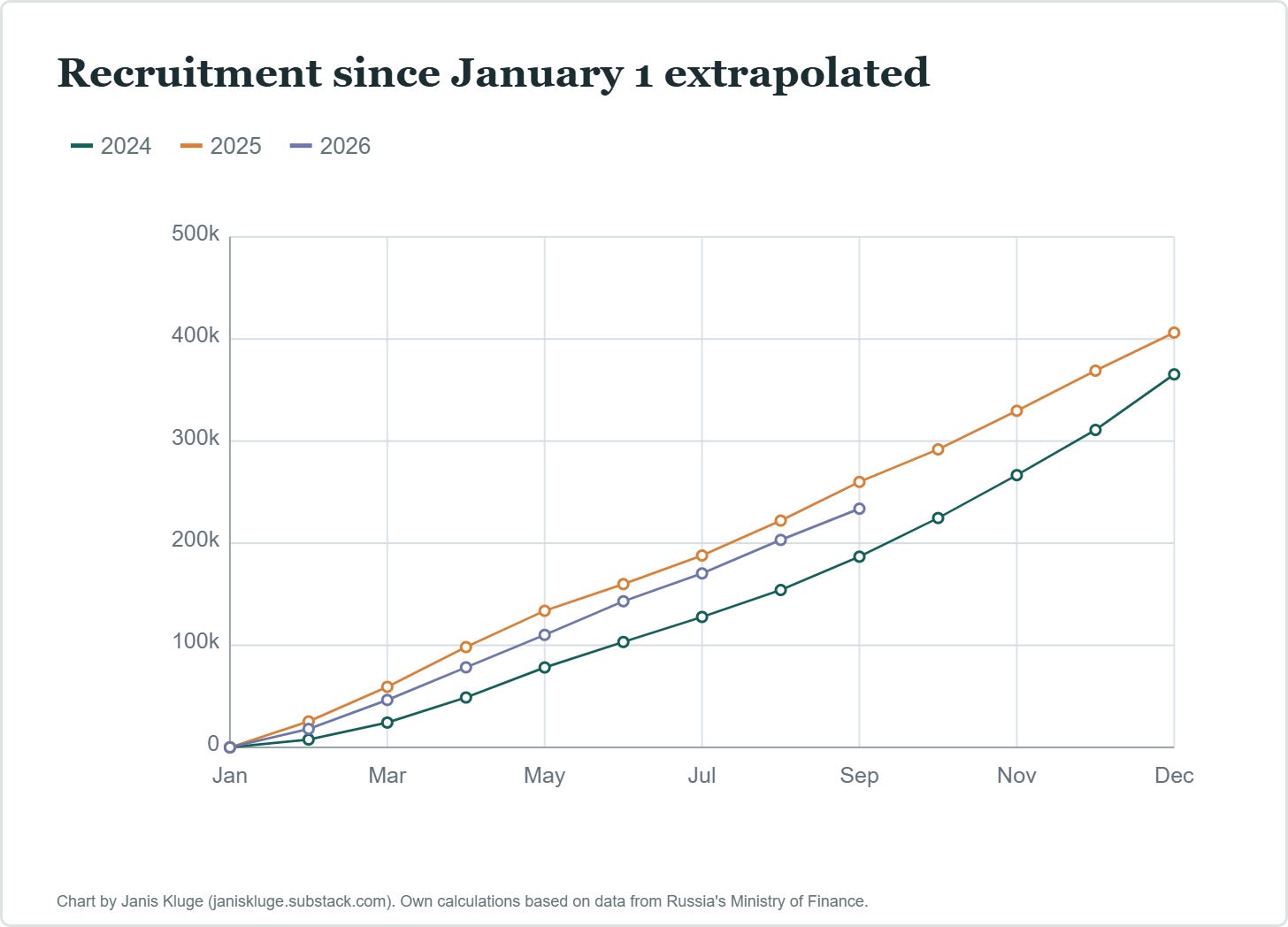
According to regional budget data, 234,000 new contracts were signed by the end of August this year, compared to 260,000 contracts in January-August 2025.
There was a slight increase in spending in the last couple of weeks, but this is most likely a seasonal pattern. There was a much more pronounced increase in the third quarter of last year.
Regional coffin money cuts
The cost of maintaining the necessary level of recruitment continues to weigh heavily on regional budgets. Meanwhile, regional tax revenues are sluggish because of Russia’s ongoing economic slowdown. The answer: budget cuts in “civilian” spending. In several cases, spending reductions were explicitly connected to the cost of recruitment. In Sakha (Yakutia), regional public sector employees saw their salary indexation postponed. According to the chairman of the regional government, the decision was taken due to unforeseen spending on payouts for contract soldiers. In Volgograd, a youth festival called “ThreeFour” was scrapped at the last minute to save money for recruitment bonuses, which (ironically) were increased to 3.4 million rubles at the same time.
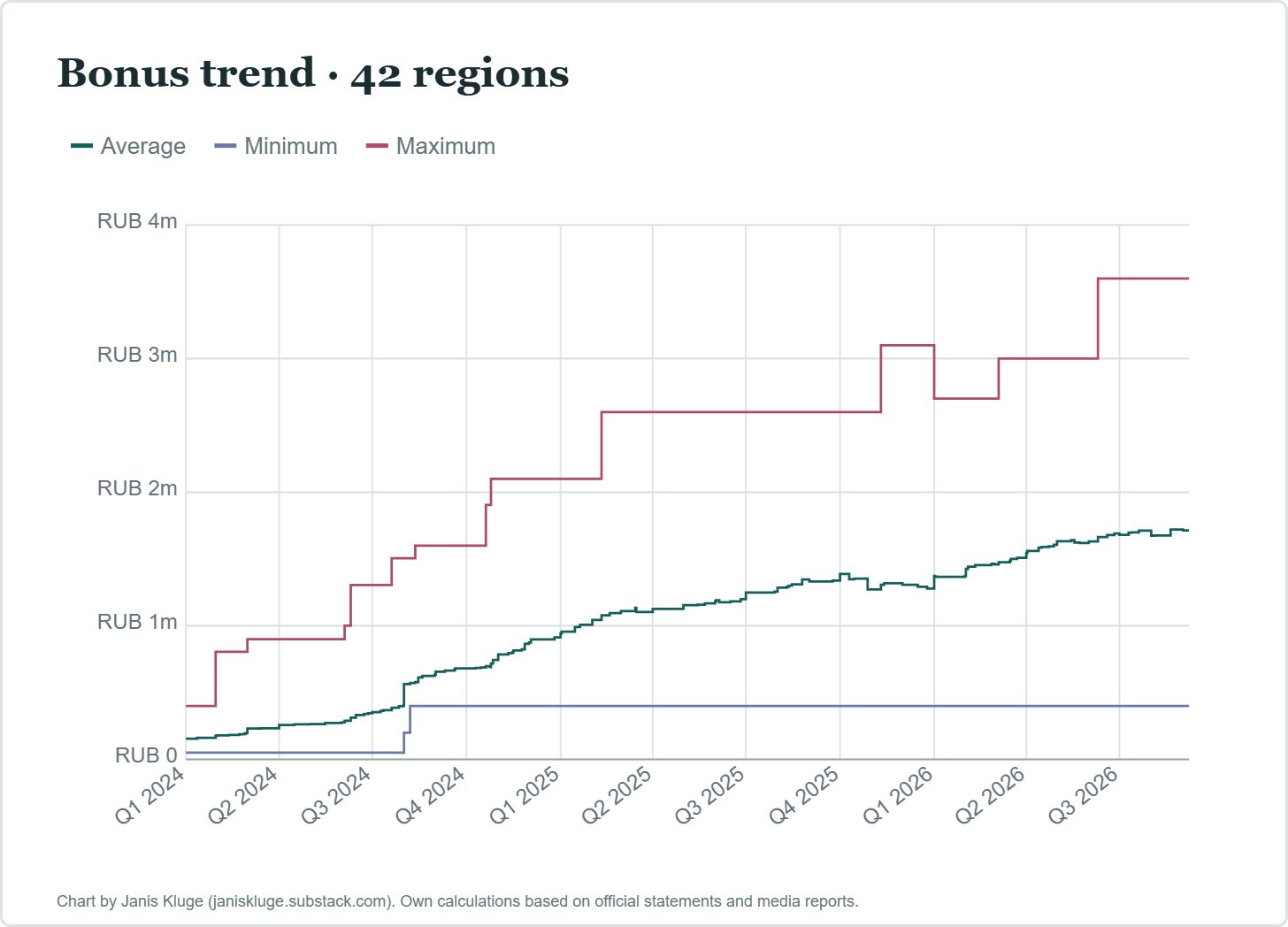
But Russian regions are not just cutting civilian spending to find funds for recruitment. They have also begun to shift funds between different types of payouts. Most notably, coffin money - the payout relatives of killed Russian soldiers are entitled to - has been reduced in several regions. This is remarkable because these payouts had been stable throughout the full-scale invasion, in contrast to sign-on bonuses, which fluctuate regularly.
Since October 2025, Bashkortostan has cut its regional payout to the relatives of killed soldiers several times, first from 2 million rubles to 1 million, then to 500,000 and finally to 100,000 rubles this year. The same has happened in Kirov and Omsk (both from 1 million to 500,000 rubles) and Ulyanovsk (from 1 million to just 50,000 rubles), while Orenburg cancelled the payment altogether from July 1st 2026.
This development is not surprising and follows a very clear political and economic rationale. Regional coffin money plays only a minor role in sustaining recruitment, the one task regional governments have to deliver on. KIA payouts are not what regions advertise to attract recruits, because nobody wants to think about their own death when they sign a contract.
Also, regional coffin money was always just a relatively small add-on to federal payouts to relatives of killed Russian soldiers, which exceed 10 million rubles per KIA. While regions have little to gain from big payments to grieving families, the perspective is different for the Kremlin. It makes more sense to pay out millions of rubles to relatives from Moscow’s perspective: It pacifies the families and it makes their neighbours jealous. Taken together, this is a very effective antidote for solidarity with killed soldiers and their families, and it becomes less likely that anti-war sentiment will gain traction and at some point motivate protest.
Russian federal budget data
Russia’s federal budget data continues to indicate a much lower rate of recruitment than regional budget data. The latest dataset (Q2) was released in mid-August. iStories calculated payouts for a total of 131,300 new contracts for the first half of 2026. The reason for the divergence between regional and federal data is most likely the seasonality of federal budget spending. In the first half of 2025, federal data indicated 127,500 new contracts, while spending in the second half of 2025 was almost twice as high, indicating another 236,400 new contracts. Accordingly, federal data can be expected to catch up to regional data again later this year.
While federal recruitment spending was not very conclusive in the second quarter, total military spending soared to over 10% of GDP in the first half of 2026, despite Russian plans to implement cuts. You can explore the data with the SWP Russian Budget Monitor, which provides an overview of both the composition of Russian military spending and the federal budget as a whole. I wrote a short analysis on the rise in Russian military spending for SWP, which you can read here:
Finally, a viewing recommendation: The Wall Street Journal recently published a short documentary on recruitment and Russia’s war boomtowns (including interviews from Ulan-Ude, Buryatia and some assessments from me).
The role of "coffin money" in DESTRUCTION of social cohesion is a novel idea for me. Makes sense, in a ghastly way. I always thought of a standard explanation - keep the families quiet and ambivalent about the gov role - "givers or takers?"
Thank you for highlighting this, aside other information.
Sign-on bonuses for contract soldiers have risen further since July 2026. In July, the regions paid an average bonus of 2,167,000 rubles; by early September 2026, the average amount had increased to 2,339,000 rubles.
This serves as evidence that recruiting new soldiers is proving difficult.
https://www.oskarmaria.de/index.php?option=com_content&view=article&id=5346:zahlungen-fuer-den-russischen-vertragsdienst-stand-06-09-26&catid=58&limitstart=2&Itemid=1645